
Sample: 61 procurement documents across commercial, municipal, educational, and infrastructure sectors
This analysis examines 61 perimeter security procurement documents drawn from commercial, municipal, educational, and infrastructure sources. It identifies:
- the five requirements buyers specify most consistently
- the five requirements they omit most consistently
- the scoring architecture that produces the outcome gap loss prevention professionals experience every year without tracing it to the procurement decision that created it.
The core finding is that buyers do not create a category for intervention at all. The question is not asked. The vendor is not scored. The outcome is not measured. And the result is that a vendor who proposes passive recording competes on equal terms with a vendor who proposes live operator verification, because the RFP never defined the distinction.
Why We Analyzed 61 Perimeter Security Procurement Documents
The perimeter security category has a growing library of integrator recommendations. None of this content analyzes how buyers actually make the procurement decision when the stakes are real and the process is formal.
Smaller operators making buying decisions through a dealer conversation or a sales presentation. But mid-to-large commercial operators, municipalities, school systems, and infrastructure owners rely on RFPs and collectively represent a significant share of the perimeter security market. Also, once an organization issues a structured RFP, the document becomes a template for subsequent purchases. The scoring architecture built into the original document shapes vendor selection for years.
The Perimeter Security Buyer’s Guide for unstaffed commercial properties argued that the category trains buyers to evaluate protection in terms of what a system includes rather than what it does. Specifically, whether it verifies that a detected event is a real threat and intervenes before the loss occurs. If that framing is accurate, it should be visible in procurement documents.
This analysis tests this hypothesis against real documents. The finding: buyers specify what they want the system to detect in precise detail, and what they want the system to do about it almost not at all.
Methodology
Sample Design
The analysis draws from 61 perimeter security RFPs collected from public procurement databases, state and federal solicitation portals, cooperative purchasing platforms, and vendor bid libraries between 2018 and 2026.
Documents qualified for inclusion if they solicited perimeter security solutions for properties with measurable after-hours risk exposure: security camera and video surveillance procurement, perimeter monitoring services, physical security services with a surveillance or monitoring component, and remote video monitoring services. Documents that solicited general access control without a perimeter-specific scope were excluded.
What We Analyzed
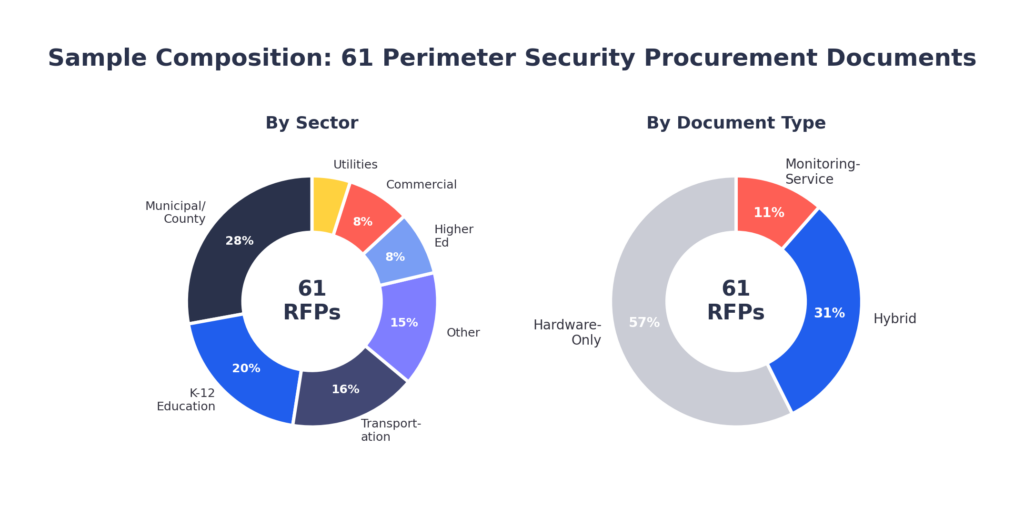
Of the 61 documents, 21 (34%) contained explicit scoring rubrics with stated percentage or point-based weights.These 21 documents form the basis of the scoring weight analysis. All 61 documents are included in the requirements frequency analysis. The sample breaks into three document types: hardware-only (35, 57%), hybrid (19, 31%), and monitoring-service (7, 11%).
Five Requirements Buyers Specify in Every Perimeter Security RFP
The five most common requirements appear in some form in the majority of documents, regardless of buyer type or organization size. Their consistency reflects how the category has been taught: what buyers understand perimeter security to include when they sit down to write the requirements section.
1. Camera Specifications: Resolution, Field of View, and Coverage Geometry
Camera specifications are the most detailed section of the average perimeter security RFP. Most documents specify minimum resolution (typically 2MP to 4K), field of view in degrees, night vision capability, weather rating (IP66 or above), and coverage geometry for specific zones.
What this signals: Buyers who specify cameras at this level have done real site assessment work. The limitation is that camera specification, however precise, is a detection-layer requirement. It says nothing about what happens after the camera sees something.
2. Recording Retention and Storage Architecture
Most RFPs specify a minimum recording retention period (30, 60, or 90 days), storage architecture (on-premises, cloud, or hybrid), and Video Management Systems compatibility requirements.
What this signals: Retention requirements reflect a post-incident evidence orientation. The organization is optimizing for the ability to review footage after a loss. This is a legitimate operational requirement. It is not a loss prevention requirement.
3. Integration with Existing Systems
Most documents require compatibility with an existing access control platform, alarm panel, or Video Management Systems. Proprietary system compatibility is commonly a scored evaluation criterion.
What this signals: Integration requirements create a scoring advantage for incumbents whose systems are already on the property, which may or may not be the vendor best positioned to deliver perimeter security outcomes.
4. System Uptime and Availability Service Level Agreements
Most RFPs include uptime requirements (commonly 99.5% or above), maintenance response time (24 to 72 hours for service calls), and backup specifications.
What this signals: Uptime service level agreements describe system availability, not system performance. A camera that is operational 99.5% of the time can still fail to prevent any losses.
5. Physical Barrier Specifications
Many documents, particularly municipal and institutional RFPs, specify fencing height, material, anti-climb features, and gate operation requirements.
What this signals: Physical barriers are the category’s oldest layer. Barriers slow intrusion. They do not verify or intervene.
The pattern across all five requirements
Every one of the five most common requirements addresses detection or documentation. None address verification or intervention: the two steps that determine whether a perimeter event turns into a loss or a stopped incident.
Five Things Buyers Consistently Miss in Perimeter Security Procurement
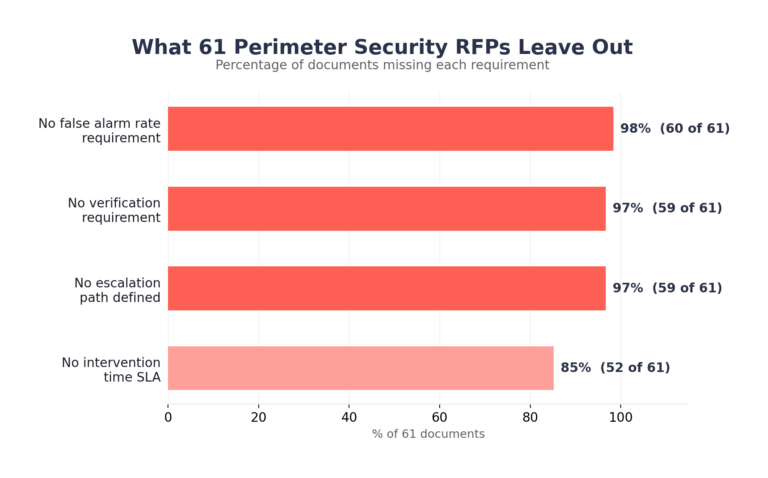
These five omissions appear across the full 61-document sample regardless of buyer sophistication, document length, or procurement budget. They are not mistakes by inexperienced procurement teams. Several of the most thoroughly researched RFPs in the sample share all five.
1. No Verification Requirement (59 of 61 documents, 97%)
Verification, the determination of whether a detected event is a real threat, does not appear as a scored evaluation criterion in 59 of 61 documents. Two exceptions exist: a major airport authority whose FAA certification manual references electronic surveillance verification procedures, and a national specialty retailer with more than 5,000 locations whose vendor profile questionnaire explicitly asks whether the vendor provides video verification before dispatching authorities.
The practical consequence: a vendor who proposes passive AI analytics that alert a property manager’s phone competes on equal terms with a vendor who proposes live operator verification with documented false alarm rates, because the RFP never asked for verification.
The Council on Criminal Justice documents that only one to five percent of alarm activations result from actual crimes. The procurement process that does not ask for verification rates is selecting vendors without knowing how often the selected vendor produces real responses versus false dispatches.
2. No False Alarm Rate or Dispatch Rate Requirement (60 of 61 documents, 98%)
False alarm rates do not appear as evaluation criteria in 60 of 61 documents. The sole exception is the national specialty retailer, which includes false alarm management as a priced line item across more than 1,000 sites and requires the vendor to confirm, process, and resolve false alarm complaints and fees.
A system that dispatches police on every activation and a system with a documented 0.38% dispatch rate will both satisfy a typical perimeter security RFP. The buyer has no mechanism to distinguish them. The system that dispatches on every activation erodes the operator’s priority standing with local law enforcement over time, an operational cost that does not appear on the security budget until it matters.
3. No Escalation Path Specification (59 of 61 documents, 97%)
When automated deterrence fails to resolve an event, when the warning plays, the strobe activates, and the intruder does not leave, what happens next? 59 of 61 documents do not specify. One state health exchange includes a defined escalation procedure to law enforcement. The national specialty retailer asks whether the vendor can customize standard operating procedures for high-risk sites and integrate with both private guard services and local law enforcement.
The escalation question is the clearest differentiator between automated deterrence systems and systems with live operator intervention. Both categories may satisfy a general monitoring and response requirement. Only one specifies what happens when automation is not sufficient.
4. No Intervention Time Service Level Agreement (52 of 61 documents, 85%)
Response time appears as a requirement in 9 of 61 documents. In nearly every case, it refers to something other than security intervention time. Consider what the sample actually shows:
“Camera criticality response: Red 2-hour, Yellow 6-hour, Green 24-hour, White 48-hour on-site response.”
Municipal government, southeastern United States. Camera maintenance and security services contract.
This is one of the most detailed response time structures in the sample. Four priority tiers, specific time commitments. Every tier describes technician response to a camera outage. None describe operator response to a security event captured by a functioning camera. The buyer built a tiered service level agreement for maintenance and no service level agreement for the operational purpose the cameras serve.
“Contractor must have ability to provide a Guard/Officer to any designated location within two hours from the time a request is made.”
County housing authority, Pacific Northwest. Professional security services contract.
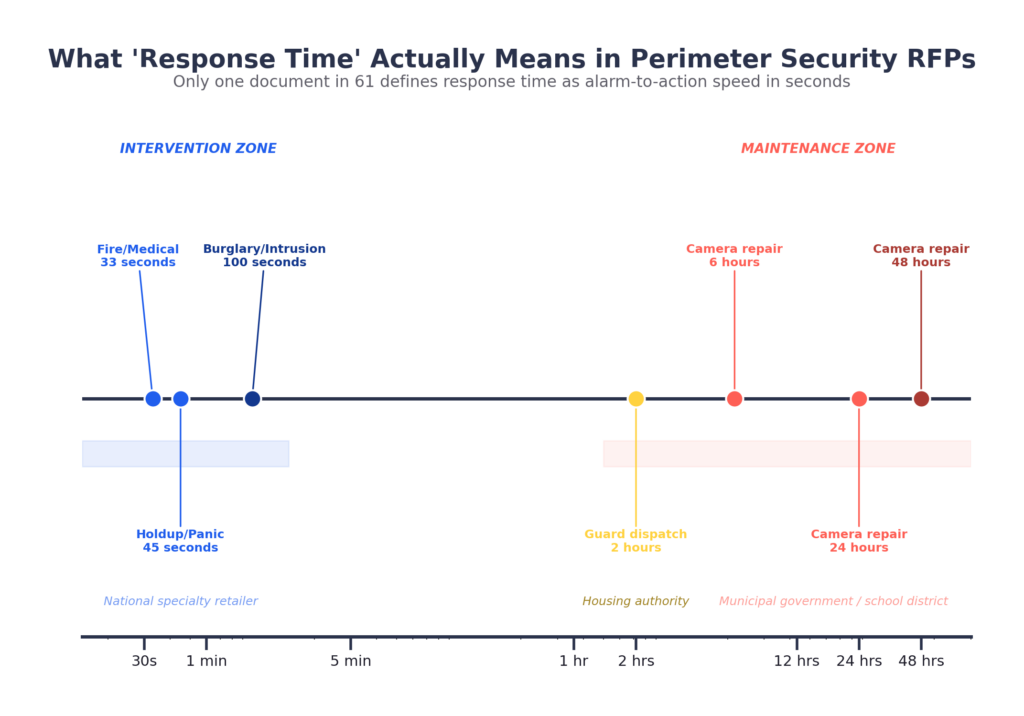
Two hours is a guard dispatch window, not a security intervention window. A perimeter breach at 2:00 AM that receives guard response at 4:00 AM is not a prevented loss.
The national specialty retailer is the only document in the sample that defines response time as alarm-to-action speed measured in seconds: 33 seconds for fire and medical, 45 seconds for holdup and panic, 100 seconds for burglary and intrusion. No other document in 61 defines response time as the time from detection to intervention action.
5. No Post-Incident Audit or Outcome Measurement Requirement
Most perimeter security RFPs define implementation deliverables: how many cameras installed, what uptime threshold maintained, what reporting schedule met. None define the outcome the system is supposed to produce over the contract term, or require the vendor to measure whether that outcome is delivered.
A vendor who installs a compliant system and provides compliant uptime reports will satisfy the contract indefinitely, regardless of whether the organization’s perimeter loss rate changes.
The Procurement Scoring Trap
The five omissions would matter less if the scoring rubric weighted intervention outcomes heavily. A buyer who assigned 30 to 40 percent of the evaluation score to quality of response and intervention model would drive vendors to differentiate on the dimension that matters most. That is not how perimeter security RFPs score.
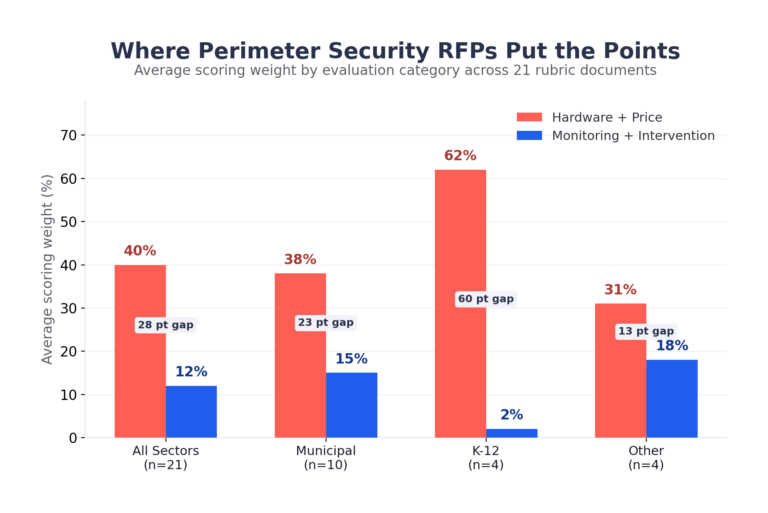
Of 61 documents, 21 contained explicit scoring rubrics with stated weights:
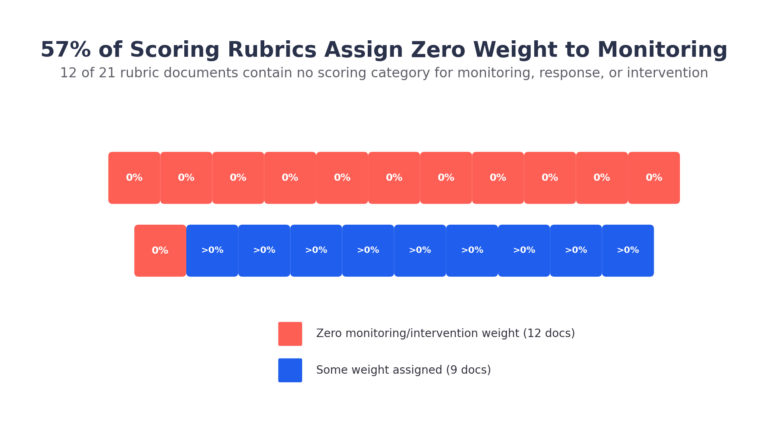
The pattern: Hardware and price account for 40% of the average scoring rubric. Monitoring and intervention account for 12%. The median monitoring and intervention weight is zero. In 12 of 21 rubric documents, no scoring category exists for monitoring, response, or intervention. The buyer did not weight it lightly. The buyer did not create the category.
The extremes illustrate the pattern. Consider this rubric from a cooperative purchasing organization that aggregates procurement for hundreds of public entities:
“Conformance to RFP: 50 pts. Financial Viability: 75 pts. Ability to Sell and Deliver: 100 pts. Marketing Plan: 50 pts. Value Added: 75 pts. Warranty: 50 pts. Depth and Breadth of Offered Equipment: 200 pts. Pricing: 400 pts. Total: 1,000 pts.”
Cooperative purchasing organization, upper Midwest. Public safety video surveillance and equipment contract.
Pricing alone accounts for 400 of 1,000 points. Depth and Breadth of Offered Equipment accounts for another 200. Combined, hardware and price categories control 60% of the scoring. No category addresses monitoring model, response methodology, verification performance, false alarm rate, or intervention time.
At the other end: a metropolitan housing authority assigned approximately 80% of its total evaluation weight to hardware and equipment specifications for a residential security camera system. Monitoring and intervention: 0%.
K-12 is the most extreme sector overall. One of the largest school districts in the country assigned 59% of its evaluation weight to hardware and price categories and 6% to monitoring and intervention. Three of the four K-12 rubric documents in the sample assign zero.
This trap is not malicious. It emerges from how procurement teams are organized. The person writing the camera specification section knows cameras. The person reviewing vendor qualifications knows how to check references. No one has been assigned to write the intervention model evaluation criteria, because no one in the room has a clear picture of what strong intervention performance looks like or how to score it comparatively.
What a Better Perimeter Security RFP Looks Like
The five omissions and the scoring trap are not reasons to avoid running a structured procurement process. They are reasons to write a different one. The requirements below are the minimum set of changes that would make a perimeter security RFP capable of selecting for intervention outcomes rather than hardware quality alone.
One document in the 61-document sample demonstrates what this looks like in practice. A national specialty retailer with more than 5,000 locations issued a procurement document that asks all four questions the other 60 documents omit: verification methodology, intervention time in seconds, false alarm management as a priced operational line item, and customizable escalation procedures for high-risk sites. That document will select a fundamentally different vendor than the other 60. Not because it uses different evaluation categories, but because it asks the questions the other 60 never thought to include.
Any procurement team can add these five elements to an existing framework without starting over.
Add a Verification Requirement
Specify how the vendor determines whether a detected event is a real threat. Acceptable methods include live operator visual verification, AI-confirmed detection logged before any dispatch, or a documented escalation from automated detection to human review within a defined time threshold. Define what constitutes a verified event for the purposes of the contract.
Replace Maintenance Service Level Agreements with Intervention Time Service Level Agreements
The response time requirement should ask: from the moment a perimeter event is detected, how long before the system takes the first action that could change the outcome? An automated voice-down system can respond in seconds. A live Interactive Security Operations Center (iSOC) operator can respond in under a minute. A guard dispatch runs in minutes to tens of minutes. Require the vendor to state this figure for each event type and hold them to it contractually.
Require False Alarm and Dispatch Rate Disclosures
Vendors should disclose, for their installed base of comparable deployments in the past 12 months: total activation volume, percentage of activations that escalated to police dispatch, and percentage of dispatches that resulted in a confirmed incident. A vendor who cannot produce these figures either does not track performance or does not want the buyer to see it.
Define Outcome Metrics for the Contract Term
Specify at minimum: annual perimeter incident count (baseline established at contract start), percentage of activations resolved without police dispatch, and change in false alarm fine volume. These three metrics are within the vendor’s operational control and directly connect to the outcomes the organization is paying for.
Score Intervention Model at 25% or Higher
No structural change produces more purchasing improvement than rebalancing the scoring rubric to give monitoring model, response time, and intervention performance a combined weight of 25 to 30 percent of the total evaluation. This single change forces vendors to differentiate on the dimension that matters most and forces the procurement team to articulate what strong intervention looks like before the proposals arrive.
The committee that cannot agree on what a 25-point intervention model score looks like has identified its most important knowledge gap. The right time to resolve it is before the vendor presentations begin.
Read the Buyer’s Guide
The detect-verify-intervene framework that this analysis applies to procurement documents is developed in full in The Perimeter Security Buyer’s Guide for Unstaffed Commercial Properties. That guide covers six delivery models, a five-question perimeter risk diagnostic, and a three-layer ROI framework.
See the Virtual Perimeter Guard
The Virtual Perimeter Guard is Interface Systems’ AI-enabled perimeter deterrence service. In a Q4 2025 deployment across 29 retail locations, it resolved 96.1% of activations through automated deterrence with a single police dispatch.
Methodology Appendix
Collection Period and Sources
Documents were collected between January 2024 and May 2026 from: Google-indexed public PDF solicitations, SAM.gov federal opportunities database (NAICS 561621 and 561612), Bonfire and BidNet public procurement platforms, Government Navigator, state procurement portals (Texas ESBD, Florida VBS, and six additional state systems), cooperative purchasing organization portals (Sourcewell), and vendor bid libraries (commercial sector documents).
Inclusion and Exclusion Criteria
Documents qualified if they solicited perimeter security solutions for properties with measurable after-hours risk exposure. Included: security camera and video surveillance procurement, perimeter monitoring services, physical security services with a surveillance or monitoring component, remote video monitoring services. Excluded: general access control without a perimeter component, cybersecurity, bodyguard or executive protection services, fire alarm systems without a security monitoring component.
Analysis Protocol
Each document was reviewed against a standardized intake form recording: source and provenance, sector classification, document type, presence of evaluation criteria, presence of scoring rubric with explicit weights, rubric category labels and weights (transcribed verbatim), and the presence or absence of requirements for verification, intervention time, false alarm rate, and escalation path. Exact procurement language was quoted verbatim for any positive finding.
Scoring rubrics were normalized to a 100-point scale. Hardware and price weight was calculated as the sum of all scoring categories addressing hardware, equipment, technology specifications, and cost. Monitoring and intervention weight was the sum of all categories addressing monitoring model, response methodology, operator capabilities, and intervention performance.
Sample Composition
Sample Bias Disclosure
Public procurement sources overrepresent municipal, county, and institutional buyers. The commercial segment (5 documents, 8%) is underrepresented because commercial buyers rarely publish formal RFPs. Findings about scoring weights are based on the 21 documents with explicit rubrics. Findings about requirement omissions are based on the full 61-document sample.
References
- Council on Criminal Justice, Burglar Alarms issue paper. Source for the one-to-five-percent false alarm rate and verified-response police policy data. Published by the Safety Reimagined initiative. safetyreimagined.org/papers/burglar-alarms
- Interface Systems, 2026 Retail Loss Prevention Benchmark Report. Source for the Q4 2025 Virtual Perimeter Guard deployment data (29 retail locations, 23,810 activations, 96.1% automated resolution, 1 police dispatch) and the 0.38 percent portfolio dispatch rate. interfacesystems.com/remote-video-monitoring/2026-retail-loss-prevention-benchmark-report/
- Interface Systems, Virtual Perimeter Guard product page. interfacesystems.com/remote-video-monitoring/virtual-perimeter-guard/
- Interface Systems, Virtual Perimeter Guard ROI Calculator. interfacesystems.com/virtual-perimeter-guard/roi/
- Interface Systems Perimeter Security RFP Teardown, 2026. Primary research. 61-document procurement analysis. Full methodology and sample composition in appendix above.